

India’s IT employment topography is shifting faster than most students realize. Across Tier-1 and Tier-2 cities alike, hiring managers are reporting a consistent trend: candidates with impressive certification lists but no hands-on experience are struggling to clear even the first round of technical interviews.
In Jaipur, a city rapidly positioning itself as a significant IT hub, this gap between credentialed knowledge and deployable skill is becoming one of the defining challenges for young professionals entering the job market.
The certificate economy grew rapidly over the past decade. Platforms promising job-ready skills in eight weeks proliferated, and students across Rajasthan responded by stacking credentials. In Rajasthan, a long list of Google Certifications, Coursera courses, and HackerRank badges became the norm, while the number of offers did not increase. The root cause is straightforward: a certificate tells an employer what you studied. It says nothing about what you can build, deliver, or troubleshoot when it counts.
TeamLease’s 2025 Employability Report states that 51% of IT managers in India prioritize project experience over certifications when hiring entry-level candidates. In Jaipur, the most in-demand skills are in IT areas such as mobile app development, UI/UX design, and full-stack development. In these areas, having a portfolio to showcase developed skills is becoming the most important differentiator when applying for jobs.
This blog makes the case for why practical, project-based IT training, especially in Jaipur, leads to more lasting, employable skills and knowledge over a certification-based approach to training, and how project-based training helps people get real IT jobs faster.
The Certificate Trap: Why Credentials Alone Are Not Converting to Offers
Certificates do indicate a level of commitment, as well as some knowledge and understanding of the subject matter. Unfortunately, they do not provide a significant advantage in what is an extremely competitive market.
The following is an example of what most likely will happen in a job interview when, instead of presenting a broad range of experience and IT skills, a candidate relies mainly on IT certifications:
- Gaps Get Exposed in the Technical Round: Standard screening tasks such as building a CRUD app, creating a responsive layout, or debugging a React component, etc., show a candidate’s ability to do the task and not just explain the theory.
- Portfolio Reviews Are Not Conducted: If candidates have only done course-related exercises, there may be nothing to show how they have thought independently or solved a problem.
- The HR Round Is Unconvincing: Without project-based outcomes, candidates are unable to respond to the interview questions “What did you build?” or “What was the problem and how did you go about solving it?” in a convincing manner.
Employers at IT companies across Jaipur, from product startups in Malviya Nagar to digital agencies in Vaishali Nagar, are not rejecting certified candidates out of preference. They are doing so because certificates, without the practical proof to back them, do not reduce hiring risk. Practical training does.
What “Practical Training” Actually Means — and Why It’s Different
The term “Practical Training” is often misrepresented. Various online sources label instruction as “hands-on labs.” Some institutions refer to a single week’s capstone project as “real-world experience.” There are significant distinctions when it comes to genuinely practical training, and these distinctions impact employability.
Genuine practical IT training is defined by the following characteristics:
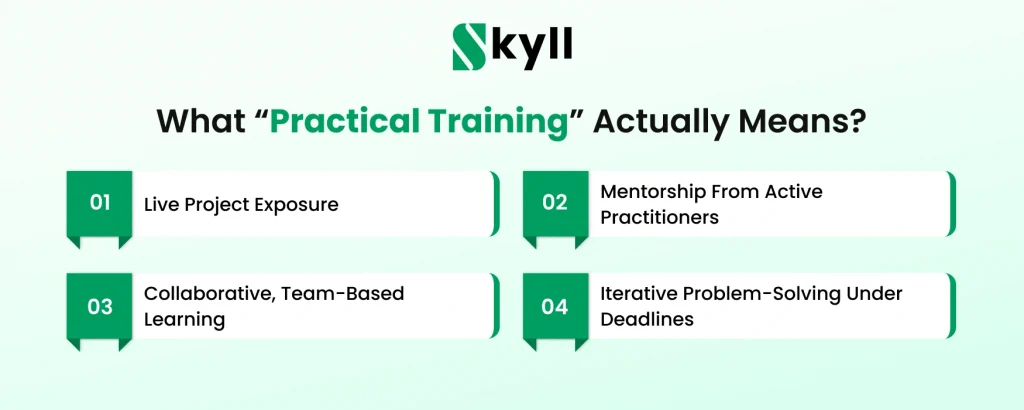
Live Project Exposure
Students work on projects that result in deliverables, be it applications, code, or designs that are ready to be presented, deployed, and even work in development. This fosters a development atmosphere and encourages iterations and exercises that are realistic.
Mentorship From Active Practitioners
The difference between a trainer who last wrote production code five years ago and a mentor who codes daily is enormous. Practitioners bring current tool stacks, real-world shortcuts, industry war stories, and insights into exactly what employers in Jaipur and beyond are looking for right now.
Collaborative, Team-Based Learning
In the real world, IT work is a collaborative effort. Practical training allows students to learn how to use Git and allows students to help code in a review. Students learn how to control and communicate the many moving parts of a project.
Iterative Problem-Solving Under Deadlines
Practical IT training aims to simulate the IT working environment as closely as possible. Creating the first (but likely incorrect) version of a project to get feedback on it is a vital part of working in IT. This is something that no IT certification will prepare you for, but practical training will.
Read More: Why Jaipur Students Need More Than a College Education to Get Hired?
Practical Training vs. Certification-Only: A Direct Comparison
| Criteria | Certification-Only Path | Practical Training Path |
| Employer Confidence | Medium: Hard to verify skills beyond certificates | High; portfolio and projects demonstrate real capabilities |
| Interview Performance | Often struggles with technical assessments and practical tasks | Strong performance through hands-on problem-solving experience |
| Time to Job Offer | Typically longer due to additional skill validation requirements | Faster because candidates are job-ready from day one |
| Salary Negotiation | Limited leverage without proven project experience | Strong leverage backed by practical work and project outcomes |
| Career Progression | Generally slower without real-world exposure | Faster growth due to workplace readiness and applied expertise |
| Mentorship Access | None or minimal support after certification | Ongoing guidance from experienced industry professionals |
Jaipur’s IT Job Market in 2026: What Employers Are Saying
In recent years, Jaipur’s technology employment sector has grown rapidly. There are now IT service companies, funded product startups, digital agencies, and outsourcing companies that together employ thousands of technology professionals.
From 2025 to 2026, hiring in Jaipur has remained strong for professionals working with the Flutter framework, the MERN stack, React JS, React Native, UI/UX design, Quality Assurance, Search Engine Optimization, and other digital marketing roles.
Conversations with hiring leads across Jaipur’s tech community consistently surface the same priorities:
- “Show me something you built.” The first thing technical interviewers typically ask in Jaipur IT hiring pools.
- “Can they contribute in week one?” The concern for small and medium enterprise tech firms that can’t sustain extended onboarding periods.
- “Do they understand the full workflow?” Project-specific training leads to candidates who understand requirement gathering, designing, building, testing, and deploying, among other processes.
Hiring Insight — Jaipur IT Market 2026
From 2023 to 2025, approximately 18,000 new IT jobs were created in Jaipur as a result of the expansion of Tier-2 operations. Currently, web and mobile developers, UI/UX designers, and digital marketers have the most openings. These roles place portfolio quality and project work the highest in their screening process, surpassing formal certifications.
The Portfolio Advantage: Why Practical Training Builds What Certificates Cannot
A portfolio is the most powerful career asset a junior IT professional can hold. It is tangible proof of competence, something that can be reviewed, tested, and verified before a single interview question is asked.
Practical IT training systematically builds portfolio assets as a byproduct of the training itself. By the time a student completes a well-structured IT job training program, they typically have:
- Two to four live or deployment-ready projects across their chosen technology domain
- A documented development process showing research, design decisions, and iteration cycles
- A GitHub profile or design portfolio demonstrating consistent activity and code quality
- At least one team-based project demonstrating collaborative workflow
- A professional LinkedIn profile with project case studies and mentor endorsements
This portfolio evidence compresses a hiring manager’s evaluation time dramatically. Rather than trying to infer competency from a certificate issuer’s reputation, the employer can evaluate the actual work. For candidates from Jaipur competing against graduates from metro cities with stronger college brands, a strong portfolio is often the great equalizer.
Why Offline, Immersive Training Produces Better Outcomes Than Online Courses
Online learning has expanded ways to access knowledge, but learning online does not equal a job-ready professional. According to the most up-to-date research, the average dropout rate of self-paced IT courses is between 80–95%. Even course completion doesn’t guarantee employment.
Due to the issues remote learning creates with accountability, consistency, and collaboration, immersive IT training proves beneficial when compared to online training
- Daily attendance builds the professional discipline that employers expect from day one
- Peer learning accelerates skill development through observation, competition, and collaboration
- Instructor immediacy allows real-time correction of conceptual errors before they become habits
- Structured project cycles with external review create the feedback loops that produce genuine skill
- Career services integration, from resume review to mock interviews to placement support, is only possible in a structured institutional environment
The immersive IT environment of Jaipur offers participants something else not found in other online courses. The training institutes immerse themselves in the local environment and connect with local IT companies to create job placement networks that online courses do not.
How Skyll’s Practical Training Approach Gets You Hired
Skyll Training Institute in Jaipur adopts a training strategy based on a single idea: the demonstration of a skill gets the job. Their training programs on the Flutter stack, MERN stack, UI/UX design, digital marketing, SEO, QA, and business analysis are designed to incorporate the delivery of live projects instead of passive classes.
While under the supervision of a mentor who practices in the industry, students generate a portfolio, receive an industry-recognized certification that includes proof of the project, and are given placement support. Skyll’s Practical Training is immersive and equips students with industry-relevant skills through live projects, expert guidance, and hands-on experience. Combined with dedicated placement support, it helps students confidently pursue career opportunities in the IT industry.

Final Thought
The IT job market in Jaipur, as well as across the entire country, has passed the phase of “What have you learned?” The question asked now is “What have you created and are you able to create it?”
While certificates can respond to the first question, only practical training responds to the second. In the current job market, employer confidence is built through practical training that demonstrates real skills, as opposed to credential-based training.
The right move for aspiring IT professionals in Jaipur is to invest in training that cultivates portfolio-building, project experience, and placement support, as well as the professional preparedness needed to convert interviews into job offers. Employers are not focused on the coursework you have completed, rather, they are focused on the practical skills you have demonstrated to them.
FAQ’s
Q1. Are certifications enough to get an IT job in Jaipur?
Ans. Certifications help demonstrate foundational knowledge, but most Jaipur IT employers also look for practical experience. Candidates with live projects, portfolios, and real-world problem-solving skills often have a stronger advantage during hiring.
Q2. Why do employers prefer candidates with practical training?
Ans. Practical training shows that a candidate can apply knowledge in real situations. It provides evidence of technical skills, project execution, teamwork, and problem-solving abilities that employers value when evaluating job readiness.
Q3. How does practical training improve interview performance?
Ans. Students who complete hands-on projects can confidently discuss challenges, solutions, and outcomes during interviews. This experience helps them perform better in technical assessments and answer employer questions with real examples.
Q4. What types of IT roles benefit most from practical training?
Ans. Practical training is especially valuable for roles such as Flutter Developer, MERN Stack Developer, UI/UX Designer, QA Engineer, Digital Marketer, and Business Analyst, where employers expect demonstrable project experience.
Q5. How does practical training help students get hired faster?
Ans. Hands-on training builds job-ready skills, creates a professional portfolio, and provides exposure to industry workflows. This reduces employer hiring risk and helps candidates transition into IT roles more quickly.
[reblex id=’188′]